Search This Blog

Tuesday, July 17, 2007

NCLEX Is For All Nurses In The World

Since a long time who Nurses want to go to USA for work as a Nurse must be certified NCLEX first without it you will be not accept to work in America and now not only USA, other country such as Australia, UK, North America, more country require NCLEX certificate and Middle east till now no NCLEX required. Why you have to taking NCLEX first? Why NCLEX is very important? What is NCLEX? NCLEX is National Council Licensure Examination. A student must pass the NCLEX in order to become a licensed registered nurse in the US. Most nursing students take the exam within 3 months after finishing nursing school. It,s require to be taken as a requirement that nurses are able to doing nursing good care in whole nursing department field. It is the same thing if you are a driver, before drive car you have to taking driving license so you will be able to drive car correctly and nicely. NCLEx is Nursing License that indicating who Nurses have NCLEX certificate is capable to doing whole health care.

NCLEX is all Nurses in the World

When I learn about NCLEX it is the best way Nurses must be taken NCLEX even though they don't want to go to USA or other country. NCLEX is the basic Nurses skill so every Nurses must familiar and full understanding with NCLEX. NCLEX study lead to the nursing skill and will be guide do the correct and fast action to the patient life. It is meant NCLEX is for all Nurses in whole world so it will be reflected to the standard nursing care in the world not only for USA nurses but for all Nurses in the world. I think in the future NCLEX standard must be applicate to Nurses in the whole world.

Monday, June 25, 2007

Skin Cancer

Do you have any spot dark in your skin? Please pay attention to evaluate and to look that the spot dark in your skin is massive growth , before anything happen to you because many people they don't know if the spot dark in their skin is early of skin cancer which called MELANOMA.

What is skin cancer?
Skin cancer is a malignant growth on the skin which can have many causes. Skin cancer generally develops in the epidermis, the outermost layer of skin, so a tumor is usually clearly visible. This makes most skin cancers detectable in the early stages.
Skin cancer is the most common form of cancer in the United States. The two most common types are basal cell cancer and squamous cell cancer. They usually form on the head, face, neck, hands and arms. Another type of skin cancer, MELANOMA, is more dangerous but less common.

What Is Melanoma?
Melanoma is a disease in which malignant (cancer) cells form in the skin cells called melanocytes (cells that color the skin). Melanocytes are found throughout the lower part of the epidermis. They make melanin, the pigment that gives skin its natural color. When skin is exposed to the sun, melanocytes make more pigment, causing the skin to tan, or darken.
Risk factors for melanoma include the following:
  • Unusual moles.
  • Exposure to natural sunlight.
  • Exposure to artificial ultraviolet light (tanning booth).
  • Family or personal history of melanoma.
  • Being white and older than 20 years.
  • Red or blond hair.
  • White or light-colored skin and freckles.
  • Blue eyes.
The following stages are used for melanoma:
Stage 0
In stage 0, melanoma is found only in the epidermis (outer layer of the skin). Stage 0 is also called melanoma in situ.

Stage I
Stage I is divided into stages IA and IB.
  • Stage IA: In stage IA, the tumor is not more than 1 millimeter thick, with no ulceration. The tumor is in the epidermis and upper layer of the dermis.
  • Stage IB: In stage IB, the tumor is either:
    o not more than 1 millimeter thick, with ulceration, and may have spread into the dermis or the tissues below the skin; or
    o 1 to 2 millimeters thick, with no ulceration.
Stage II
Stage II is divided into stages IIA, IIB, and IIC.
  • Stage IIA: In stage IIA, the tumor is either:
    o 1 to 2 millimeters thick, with ulceration; or
    o 2 to 4 millimeters thick, with no ulceration.

  • Stage IIB: In stage IIB, the tumor is either:
    o 2 to 4 millimeters thick, with ulceration; or
    o more than 4 millimeters thick, with no ulceration.

  • Stage IIC: In stage IIC, the tumor is more than 4 millimeters thick, with ulceration.
Stage III
In stage III, the tumor may be any thickness, with or without ulceration, and:
  • has spread to 1 or more lymph nodes; or
  • has spread into the nearby lymph system but not into nearby lymph nodes; or
  • has spread to lymph nodes that are matted (not moveable); or
  • satellite tumors (additional tumor growths within 2 centimeters of the original tumor) are present and nearby lymph nodes are involved.
Stage IV
In stage IV, the tumor may be any thickness, with or without ulceration, may have spread to 1 or more nearby lymph nodes, and has spread to other places in the body.

How to reduce from Skin Cancer?
The following steps have been recommended by the American Academy of Dermatology and the Skin Cancer Foundation to help reduce the risk of sunburn and skin cancer.
  • Minimize your exposure to the sun at midday and between the hours of 10:00AM and 3:00PM.
  • Apply sunscreen with at least a SPF (Sun Protection Factor)-15 or higher, to all areas of the body which are exposed to the sun. Reapply sunscreen every two hours, even on cloudy days. Reapply after swimming or perspiring.
  • Wear clothing that covers your body and shades your face. (Hats should provide shade for both the face and back of the neck.)
  • Avoid exposure to UV radiation from sunlamps or tanning parlors. Protect your children. Keep them from excessive sun exposure when the sun is strongest (10:00AM and 3:00PM), and apply sunscreen liberally and frequently to children 6 months of age and older. Do not use sunscreen on children under 6 months of age. Parents with children under 6 months of age should severely limit their children's sun exposure.
Four types of standard treatment are used:
  1. Surgery

  2. Surgery to remove the tumor is the primary treatment of all stages of melanoma. The doctor may remove the tumor using the following operations:

    • Local excision: Taking out the melanoma and some of the normal tissue around it.
    • Wide local excision with or without removal of lymph nodes.
    • Lymphadenectomy: A surgical procedure in which the lymph nodes are removed and examined to see whether they contain cancer.
    • Sentinel lymph node biopsy: The removal of the sentinel lymph node (the first lymph node the cancer is likely to spread to from the tumor) during surgery. A radioactive substance and/or blue dye is injected near the tumor. The substance or dye flows through the lymph ducts to the lymph nodes. The first lymph node to receive the substance or dye is removed for biopsy. A pathologist views the tissue under a microscope to look for cancer cells. If cancer cells are not found, it may not be necessary to remove more lymph nodes.

    Skin grafting (taking skin from another part of the body to replace the skin that is removed) may be done to cover the wound caused by surgery.

    Even if the doctor removes all the melanoma that can be seen at the time of the operation, some patients may be offered chemotherapy after surgery to kill any cancer cells that are left. Chemotherapy given after surgery, to increase the chances of a cure, is called adjuvant therapy.

  3. Chemotherapy

  4. Chemotherapy is a cancer treatment that uses drugs to stop the growth of cancer cells, either by killing the cells or by stopping them from dividing. When chemotherapy is taken by mouth or injected into a vein or muscle, the drugs enter the bloodstream and can reach cancer cells throughout the body (systemic chemotherapy). When chemotherapy is placed directly into the spinal column, an organ, or a body cavity such as the abdomen, the drugs mainly affect cancer cells in those areas (regional chemotherapy).

    In treating melanoma, anticancer drugs may be given as a hyperthermic isolated limb perfusion. This technique sends anticancer drugs directly to the arm or leg in which the cancer is located. The flow of blood to and from the limb is temporarily stopped with a tourniquet, and a warm solution containing anticancer drugs is put directly into the blood of the limb. This allows the patient to receive a high dose of drugs in the area where the cancer occurred.

    The way the chemotherapy is given depends on the type and stage of the cancer being treated.

  5. Radiation therapy

  6. Radiation therapy is a cancer treatment that uses high-energy x-rays or other types of radiation to kill cancer cells or keep them from growing. There are two types of radiation therapy. External radiation therapy uses a machine outside the body to send radiation toward the cancer. Internal radiation therapy uses a radioactive substance sealed in needles, seeds, wires, or catheters that are placed directly into or near the cancer. The way the radiation therapy is given depends on the type and stage of the cancer being treated.

  7. Biologic therapy

  8. Biologic therapy is a treatment that uses the patient’s immune system to fight cancer. Substances made by the body or made in a laboratory are used to boost, direct, or restore the body’s natural defenses against cancer. This type of cancer treatment is also called biotherapy or immunotherapy.

    New types of treatment are being tested in clinical trials. These include the following:

  9. Chemoimmunotherapy

  10. Chemoimmunotherapy is the use of anticancer drugs combined with biologic therapy to boost the immune system to kill cancer cells.
Keep your skin away from Skin Cancer, do the right way, how to avoid skin cancer.
Sources:
www.maui.net
www.nlm.nih.gov
en.wikipedia.org
http://www.cancer.gov

Saturday, June 16, 2007

Blood Tranfusion

What Is Blood Transfusion?
Blood Transfusion is a process of transferring blood or blood-based products from person to other person according to Blood grouping matching(A, B, AB, or O)and each type have 2 Rhesus (REE-sus) or "Rh" types should be matching too. The Rh types are positive and negative. All blood, even O negative blood, can have antibodies (AN-ti-bah-dees).

When you need Blood Transfusion?
Blood transfusions can be life-saving in some situations and will be given who anybody want to do surgery procedure or getting massive blood loss due to trauma, or can be used to replace blood lost during surgery. Blood transfusions may also be used to treat a severe anaemia or thrombocytopenia caused by a blood disease. People suffering from hemophilia or sickle-cell disease may require frequent blood transfusions.

Does Blood Transfusion safe?
If the blood transfusion given to other person precede by screened it will be save to the patients live, but if it's not screened it will be transfer many disease to the recipient through transfusion transmitted infections (TTIs) such as HIV, Hepatitis B, Hepatitis C and Syphilis from blood donated. Therefore donated blood should be tested for other infections such as Chagas Disease and Malaria. Blood is also tested to identify the blood group and for the presence of irregular red cell antibodies before transfusion. This is to make sure the patient who will receive compatible blood in order to avoid serious haemolytic transfusion reactions.

Transfusion Procedure
  1. Ensure each pack is label with A,B,O and rhesus (D) group and the individual component number also record on the blood product document.
  2. Check the patient identity on the blood product document againts the patient
    wrist bend.
  3. Prior administration, record details, on the blood component infusion in the patient note, including date, time of issue, product pact number, ordering medical officer, given by, checked by, time started.
  4. Infuse all blood component through giving set whit an integral filter to trap large aggregates. Microaggregate filter are not routinely require.
  5. Never add any drug to a blood component infusion.
  6. Do not use giving set which previously contained dextrose or gelatin.
  7. Red cell concentrates may be diluted with 0.9% saline using a Y giving set to improve flow rates. Never add any other solution.
Complication of Blood Transfusion
Rapid infusion of blood products may lead to hypothermia. Blood product are normaly store 2-6 celcius deggre. Use blood warmers routinely for rapid transfusion. Never warm a blood product by putting a pack into hot water, on radiator, or any other heat source.
Occasionally complications caused by blood transfusions as a below:
  • Fluid overload - this common side effect can be lessened by slowly introducing the donated blood.
  • Allergic reaction - the most common complication. The recipient’s immune system treats the donated blood products as a threat. Symptoms include itching, dizziness, headache and difficulties in breathing.
  • Haemolytic reaction - occurs if the recipient is given the wrong type of blood. The transfused red blood cells are killed off. Symptoms include a feeling of pressure in the chest, back pain and difficulties in breathing. Haemolytic reaction can sometimes be life threatening.
  • Graft versus host disease - where the donated white blood cells destroy the recipient’s cells. The symptoms include low blood pressure and fever. It is also life threatening.
Transfusion Reaction
Monitor the patient especially closely the firsts 5-10 times of the infusion of the each unit of blood to detect early clinical evidence of acute reactions. Treat allergic reaction include itching, urticaria, bronchospasm, and fever.
If a transfusion reaction is suspected:
  • Stop the transfusion.
  • Keep the IV line open with 0,9% saline.
  • Double check the blood unit label with the patient's wrist identity band and other identifiers.
  • Send the unit of blood product and giving set to the blood bank.
  • Take 40 mL of blood. Send it as follows:
  • 5 mL anticoagulated and 5 mL clotted blood to blood bank.
    10 mL for u&E.
    10 mL for coagulation screening.
    10 mL for blood culture.
  • Contact the blood bank directly by phone for further advice and if further transfusion is required


Friday, June 08, 2007

New Drug for Advanced Kidney Cancer

The U.S. Food and Drug Administration (FDA) may,30,2007 approved Torisel (the generic name is temsirolimus) for the treatment of a certain type of advanced kidney cancer known as renal cell carcinoma. Torisel was approved based on a study that showed use of the drug prolonged survival of patients with renal cell carcinoma. The drug is an enzyme inhibitor, a protein that regulates cell production, cell growth and cell survival.

"We have made significant advances in the battle against kidney cancer,” said Steven Galson, M.D., M.P.H., director of the FDA’s Center for Drug Evaluation and Research. "Torisel is the third drug approved for this indication in the past 18 months, and one that shows an increased time in survival for some patients."
The approval of Torisel follows the December 2005 approval of Nexavar (sorafenib), which was based on a delay in progression of disease. In January 2006, Sutent (sunitinib) received accelerated approval based on durable response rate, or tumor size reduction, and was later demonstrated to delay tumor progression.

The safety and effectiveness of Torisel were shown in a clinical trial of 626 patients divided into three groups. One group received Torisel alone, another received a comparison drug called Interferon alfa, and a third received a combination of Torisel and interferon.

The group of patients who received Torisel alone showed a significant improvement in overall survival. The median overall survival was 10.9 months for patients on Torisel alone versus 7.3 months for those treated with the interferon alone. Progression-free survival (when the disease does not get worse) increased from 3.1 months on the interferon alone arm to 5.5 months on the Torisel alone arm. The combination of Torisel and interferon did not result in a significant increase in overall survival when compared with interferon alone.

The most common adverse reactions, occurring in at least 30 percent of Torisel-treated patients, were rash, fatigue, mouth sores, nausea, edema, and loss of appetite. The most common laboratory abnormalities were high blood sugar, elevated blood lipids and triglycerides, elevated liver and kidney blood tests, and low red cell, white cell, and platelet counts.

Renal cell carcinoma, diagnosed in about 51,000 people annually in the United States, accounts for about 85 percent of all U.S. adult kidney cancer.

Torisel is manufactured by Philadelphia-based Wyeth Pharmaceuticals, Inc
Important Safety from used Torisel
Source

Sunday, June 03, 2007

Cardiopulmonary Resuscitation (CPR)


What Is CPR (Cardiopulmonary Resuscitation)
CPR is combination of rescue breathing(to get oxygen to the lungs) and chest compressions (to keep blood circulating) delivered to victims to save of patient life when a person experiences cardiac arrest, whether due to heart failure in adults and the elderly or an injury such as near drowning,suffocation, poisoning, smoke inhalation, electrocution or severe trauma in the child and newborn.

Cardiac arrest is often caused by an abnormal heart rhythm called ventricular fibrillation (VF). When VF develops, the heart quivers and doesn't pump blood. The victim in VF cardiac arrest needs CPR and delivery of a shock to the heart, called defibrillation. Defibrillation eliminates the abnormal VF heart rhythm and allows the normal rhythm to resume. Defibrillation is not effective for all forms of cardiac arrest but it is effective to treat VF, the most common cause of sudden cardiac arrest.

CPR may not save to the victim even when performed properly, but if started 4 minutes of cardiac arrest and defibrillation is provided whitin 10 minutes, a person have 40% chance of survival. Here the CPR time line described you have to do CPR , if you are doing CPR starting 0-4 minutes you can save from brain damage, 4-6 minutes brain damage possible happen, 6-10 minutes brain damage probable and over 10 minutes probable brain death, so choose the right time when you are perform CPR.

To make learning CPR is easier , you have to remember the sequence letters A-B-C as explained the following:
  1. A : Airway
  2. B : Breathing
  3. C : Circulation
When CPR to be Perform?

CPR is most successful when administered as quickly as possible, but you must first determine if it's necessary. It should only be performed when a person isn't breathing or circulating blood adequately.

How to perform CPR?


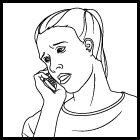
You should not try CPR unless you have had training - if it is done incorrectly, it could harm someone and will killing victim try to looking some help or you can calling victim, you have to be skill full, and to keep your skill up, you should repeat the training every two years. You can call 9-1-1 in USA, UK 9-9-9 or you can call any Emergency Care in your own country, or you can contact local Ambulance number if you have it.

If yo can do CPR, Remember the ABCs
Airway, Breathing and Circulation — to remember the steps explained below.

AIRWAY: Clear the airway

  1. Put the person on his or her back on a firm surface.
  2. Kneel next to the person's neck and shoulders.
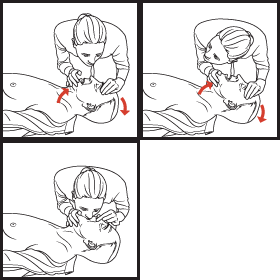
  3. Open the person's airway using the head tilt-chin lift. Put your palm on the person's forehead and gently push down. Then with the other hand, gently lift the chin forward to open the airway.
  4. Check for normal breathing, taking no more than 10 seconds: Look for chest motion, listen for breath sounds, and feel for the person's breath on your cheek and ear. Do not consider gasping to be normal breathing. If the person isn't breathing normally or you aren't sure, begin mouth-to-mouth breathing.
BREATHING: Breathe for the person

Rescue breathing can be mouth-to-mouth breathing or mouth-to-nose breathing if the mouth is seriously injured or can't be opened.
  1. With the airway open (using the head tilt-chin lift), pinch the nostrils shut for mouth-to-mouth breathing and cover the person's mouth with yours, making a seal.
  2. Prepare to give two rescue breaths. Give the first rescue breath — lasting one second — and watch to see if the chest rises. If it does rise, give the second breath. If the chest doesn't rise, repeat the head tilt-chin lift and then give the second breath.
  3. Begin chest compressions — go to "CIRCULATION" below.
CIRCULATION: Restore blood circulation
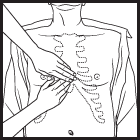
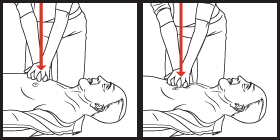
  1. Place the heel of one hand over the center of the person's chest, between the nipples. Place your other hand on top of the first hand. Keep your elbows straight and position your shoulders directly above your hands.
  2. Use your upper body weight (not just your arms) as you push straight down on (compress) the chest 1 1/2 to 2 inches. Push hard and push fast — give two compressions per second, or about 100 compressions per minute.
  3. After 30 compressions, tilt the head back and lift the chin up to open the airway. Prepare to give two rescue breaths. Pinch the nose shut and breathe into the mouth for one second. If the chest rises, give a second rescue breath. If the chest doesn’t rise, repeat the head tilt-chin lift and then give the second rescue breath. That's one cycle. If someone else is available, ask that person to give two breaths after you do 30 compressions.
  4. If the person has not begun moving after five cycles (about two minutes) and an automated external defibrillator (AED) is available, open the kit and follow the prompts. If you're not trained to use an AED, a 911 operator may be able to guide you in its use. Trained staff at many public places are also able to provide and use an AED. Use pediatric pads, if available, for children ages 1 to 8. If pediatric pads aren't available, use adult pads. Do not use an AED for infants younger than age 1. If an AED isn't available, go to Number 5 below.
  5. Continue CPR until there are signs of movement or until emergency medical personnel take over.

sources
1.www.mayoclinic.com
2.www.learncpr.org
3.www.americanheart.org

Sunday, May 20, 2007

Back Pain In Nurses

Nurses is one profession who have susceptible getting low back pain under their daily activity if they don't take care . The daily activity such as , bed making, turning bed-ridden patients, transferring among stretchers, beds and chairs, move patients from bed to wheelchair, indeed if the patient was unconscious, emergency cases, nurses ignore doing safety to their self for example nurses who work in emergency department and ICU who all patients are high dependent attention and fast action from nurses, so some time they didn't care to their safety first because they want to safe to the patients of life.Nurses must have knowledge to understand about safety procedure how to doing manual handling in the hospital area or safety officer department must be control to nurses activity with safety procedures, without knowledge and safety control injuries and back pain cases come out lead.
Dr.Edgar Viera, a doctoral student in the University of Alberta Faculty of Rehabilitation Medicine said,"Nurses suffer from work-related low back pain more often than workers in other professions. It is point out number of nurses suffering back pain is still high, why? Do you still lets your safety away? did you think that safety is number two, doing something with safety first to save your life comfortin the future.
Related to the study of back pain factors above here some way to reduce nurses back pain when they are doing activities in Hospital as following:

  1. Using lifting assistance devices

  2. A variety of devices is available to help lift and move patients from bed to seat, such as:

    • Gait belt: This is a special belt that fit snugly around the patients waist and has hand starsp for the nurse or caregiver to grasp while assisting during transfers or walking.
    • Walkers: Lightweight metal frame devices with rails that can be gripped by the patient to help to support their body weight during transfer and rising from sitting.
    • Rails: Wooden or metal rails are fixed to walls or equipment , such as beds, to allow the patient to help to support their body weight during transfer.
    • 'Hoyer' Lifts: A hydraulic lift that consists of a metal frame and a heavy canvas swing. It is capable of lifting and suspending a patient for transfer.
    • Sliding boards: A smooth board with tapered ends made of either wood or plastic that is used to help someone get from one sitting surface to another.
    • Draw/lift sheets: A regular flat sheet placed under a patient in the bed can be used to move them. If the sheet is strong enough it can also be used to lift and transfer the patient.
  3. Using appropriate equipment: There is a choice of powered equipment available to reduce patient handling activities, such as powered beds to change a patient's posture, height adjustable chairs, and powered wheelchairs.
  4. Use appropriate beds: The height of the bed determines how much bending and reaching a nurse has to do. Nurse are different heights, so a simple to operate, height-adjustable bed is important to allow bed height to be appropriately adjusted to the nurse.
  5. Use back belt: use back belt when lift a patient with heavy weight to prevent your back bone from injury or dislocation
  6. Implement regular maintenance procedures: Equipment must be keep in good working order so anytime will be ready to be use.

Other safety support is important also included:

  1. Ergonomic design of workplaces: Use architectural and design features, such as rails or ramps, to minimize awkward movements.
  2. Providing better ergonomic training: Train nurses and health aides in good work posture and ways of minimizing twisting, bending and/or lifting items from the floor. Also train them in safe lifting practices, and in the correct use of appropriate equipment. Provide ways os refreshing and reinforcing the training.
  3. Provide adequate staffing: Injury risk can be reduced by increasing the number of people available to assist with lifting patients.
  4. Systematic record-keeping: Implement processes that facilitate more detailed statistic on manual handling activities and outcome so that this can help to identify injury trends before more serious incidents occur.
Safe your life to be comfort in the future from getting back pain or low back pain, or injury!!!

Monday, May 14, 2007

Nurse Jobs Opportunities In Qatar Petroleum

Dear all nurses in whole world
This is good info to nurses who looking for a new job , or even you have had been already good job, so you can compare or want to move to other area with the good chance, why because as my experience Qatar Petroleum offering best reward to nurses who have qualification as well as they needed.
Qatar Petroleum is one of biggest company that produce oil and gases offering many jobs opportunities, one of them is nurse jobs. Are you nurses who have experiences more than 5 years or more, you like challenging jobs in oil and gas area who will place you in offshore or onshore, if you are nurses who have qualified of ACLS , ATLS, emergency background and ambulance skill so what are you waiting for, let,s join with Qatar Petroleum to increase your benefits.
Qatar Petroleum offering many benefits to you as a following:
  • Salary attractive more than $1500 per month
  • Biannual leave in year
  • Full accommodation
  • Full health insurance
  • Allowed to your spouse settle with you
  • Free education for your children
  • Free air plane ticket till your destination place when you are vacation
  • Many others benefits
Why you still conscious , wary, let's open your eyes, you want to get more information, visit to Qatar Petroleum web site or you can apply HERE will be bring you to application form, prepare requirements that they need and keep on your computer document, as a below:
  • C.V.
  • Certificate of your Nursing Study ( Diploma or BSN)
  • ACLS certificate
  • ATLS certificate
  • Experience background
  • Other certificate if you have it
Try to get chance and quick online apply.
For Indonesian Applicants, please contact toPT. Guna MandiriThank for your attention
Nurses Web Blog Team

Saturday, February 10, 2007

How is Viagra Helpful To YOU ?


What is Viagra?
Viagra(Sildenafil citrate), sold under the names Viagra, Revatio and generally under various other names, is a drug used to treat male of erectile dysfunction (impotence)developed by the pharmaceutical company Pfizer. The other medicines which can support for sexual activity are Vardenavil(Levitra) and Tadalafil (Cialis).

How are Viagra, Levitra and Tadalafil work?
Viagra,Levitra and Tadalafil are prevent the breakdown of nitric oxide , chemical messenger that promotes relaxation and opening of the blood vessel supply erectile in the penis. Under the influence of nitric oxide, these vessel expand an stay dilated. Increased blood flow makes erectile tissue swell and compress the veins that carry blood out of the penis, resulting in a full erection.
This medicines till now still helpful and many men looking for it used for increase them sexual activity. Many men who have no sexual disorder also using for to take longer them sexual activity, so it is useful for man who have no sexual problem?

What is Viagra recommended for?
Viagra is a recommended only for who everyone have sexual activity problem, especially erectile dysfunction, so for man who have no sign and symptom of sexual activity erectile dysfunction will not take effect for it, even take effect the effect will not significant but sometimes makes forth serious problem, so don,t used Viagra without doctor recommended or prescribed. In testing researches found that men with Diabetes or who had undergone radical prostate surgery were less likely to benefit. The drug also should not be taken with nitroglycerin and patches.
Dr. Harin Padma - Nathan of University of Southern California s or said," This drug does not change libido or desire and it,s not going to have any impact on normal men, so this drug is only effective in men with sexual dysfunction and should be prescribed as an"aphrodisiac" in healthy men.

Dosage
As with all prescription drug, proper dosages is at the discretion of a licensed medical doctor. The tho of sildenafil is 25 mg to 100 mgtaken once per day between 30 minute and an hour prior to sexual activity. The best way is consulting with your doctor first to avoid problem or worse side effect.

Contraindication:
Contraindication include are:
  • When taking nitric oxide donors, organic nitrites and nitrates, such as glyceryl trinitrate (nitroglycerin), sodium nitroprusside , amyl nitrite (poppers).
  • In men for whom sexual intercouse is inadvisable due to cardiavascular risk factors.
  • Severe hepatic impairment (decresed liver function).
  • Severe inpairment in renal function.
  • Hepertension (High blood pressure) and Hypotension (Low blood pressure).
  • Recen stroke or heart attack.
  • Hereditary degenerative retinal disorders (including genetic disorders of retinal phosphodiesterasess).
Side effects
Among sildenafil's serious adverse effects are : priapism, severe hypotension myocardial infarction, ventricular arrhythmias,sudden death, stroke, and increased intraocular pressure.
Common side effects include sneezing, headache, flushing, dypspepsia, prolonged erection, palpitation, and photophobia. Visual chnages including blurring of vision and a curious bluish tinge have also been reported.

If you want to share your experience or just want to compare any side effects for it, JUST VISIT HERE
Referencies:
Wikipedia
Medicines info
Yahoo.health

Saturday, December 23, 2006

Nurse Jobs In Ministry Of Health Kuwait

Short Nurses Vacancy Info
Kuwait is small country grow up of build many sectors. In Minystry Of Health, especialy in Nursing Departement still need more nurses to be placement to many departement and Hospital,if you are nurses have experiences more than 2 years, fluent english wrote and spoke so you are litle understand arabic or even you do not understand arabic you can apply righ now to ministry of health by local exam or through by your agency ,posted your application and start to join with Kuwait Ministry Of Health (MOH)


WHAT THE BENEFITS WILL YOU GET?

Many benefits that they offering are including good salary, accommodation, transportation, Health Insurance, annualy leave 1 month up or depend on your balance annual leave in year, Emergency leave till 2 weeks, sick leave depend on your condition or health problem. Salary is attractive starting minimum 250 Kd - 500Kd (825 - 1650 us dollars), depend on your nursing study graduated and experiences, if you are diploma you will get starting 800 - 1000 us dollars, if you are work in clinic, if in Hospital you will be get more extra hospital salary and night shift allowance till 60-100 Kd Kd(198-330 us dollars), but if you graduated from BSN, you will get till 1650 us dollars.
If you want to get deep more information, just visit to MOH KUWAIT

Indonesian Applicants please contact to PT.Binawan Inti Utama, PT. GUNAMANDIRI PARIPURNA,

Nurses Apartment Building In KuwAiT


Thursday, December 14, 2006

What Is Hypertension?


Almost every people ever been got the headache or dizziness, felling of lightheadedness in one their life cyle sometimes we never care but if the condition take place every time, you have to pay attention to check your self. I think you must be consultation with your physician to examine your body. Headache is one out of sign and symptom from High Blood PressureThe following question, guide you to know what is The HYPERTENSION as a below:

What Is High Blood Pressure?
Blood Pressure always given as two numbers, the systolic and diastolic numbers pressures. Both are important.Ussualy they are written one above or before the other, for example,your blood pressure is 120/80 mmHg. The top or first, numbers is the systolic and the bottom, or second numbers is the diastolic, so you can says that your blood pressure is "120" over "80". Eventhough , the numbers which using to determining Hypertension is diastolic according to WHO regulation that mentioned as a classification into three stage of Hypertension:

  1. Degree 1st is the diastolic of blood pressure was 95-109 mmHg

  2. Degree 2nd is the diastolic of Blood Pressure was 110-119 mmHg

  3. Degree 3th is the diastolic of blood pressure was over than 120 mmHg


What causees high blood pressure?
Many causes of hypertension had known such as:

  1. Age. Related lead of aged of people the blood pressure so increase, this condition take place because the blood vessels become more brittle with age and also are not flexible, wall of blood vessel to become narrow, finnaly heart pump force to be strong that result in HIGH BLOOD PRESSURE .

  2. Are a man over the age of 45 or a woman over the age of 55

  3. Overweight or obese

  4. Family history, if you have family history with Hypertension, it's easily you are develope Hypertension

  5. Face high level stress. In some studies, anger, stress, hostility and other personality traits have been shown to lead to high blood pressure, so pay attention to release any stress, anger, or reduce many problems to become relaxs it will be help you from Hypertension

  6. Eat a diet high in saturated fat

  7. Smoking

  8. Eat a diet high in salt

  9. Drink more than moderate amount of alcohol

  10. Have diabetes mellitus dissease


What is worse complication of Hypertension?
Hypertension could be damage to many body part organ involves brain (Stoke), eyes (Blindess), kidneys( Kidneys Failure), heart ( Congestive Heart Failure), extremitas (plegi) if is not treated well and uncontroled regulary, so take action soon if you have been Hypertension diagnosted establish.

How is your blood pressure treated?
Hypertension treatment is not depend only medicines, the treatment must be comprenhensive including medicines, behaviour, life style. The third programs must be took action to keep your blood pressure always stabil. Several ways to keep and to manage your blood pressure stabil you have to do such a below:
  • Learn how to manage stress

  • Start eating a low-fat and low salt-diet

  • Doing routine exercises such as jogging,light sport,etc

  • Keep your weight nearly normal, or reduce your overweight to be normal

  • Take your medicines as doctor prescribed

  • Checked routine your blood pressure or if feeling severe headache,chestpain,blurred vision, numbness, dizziness

  • Avoid heavy activity to avoid overload your heart pump which will lead your blood pressure

  • If you are smoker, please quite from it, so you,ll more healthy

  • Retrain from drink alcohol or at all

  • Visit to your doctor if you have been performed all that thing above, but still have not been feeling well
  • Sunday, December 10, 2006

    Meaning Of The 1st December Of AIDS Day

    1st December is the day of AIDS day , so what will we do for. We always remember that AIDS case lead every day ,so we must be care and take action for this soon to stop spread of NEW AIDS CASE through by campaign to every body with build save behaviour from AIDS case including avoid FREE SEX, having sex with legal partner through marriage. Why we do like that, because around forty million people are living with HIV throughout the world and that number increases in every region every day.
    What can I do to support World AIDS Day?
    There are so many ways in which you can support to do to stop AIDS spreading with many ways like a following:

    1. Raise awareness of HIV and AIDS in your area, use any safety device when handle patient especialy in hospital area such as nurse, doctor, and any worker related with high risk HIV / AIDS infected

    2. Avoid Free Sex, because Free Sex may cause spreading HIV to each partner who have no HIV previously even though we have protected by condom and any ways, but even we doing like that condom is not have enaugh 100% save from HIV infected

    3. Getting your friends, family, collegues or pupil to express their felling and expand their knowledge about HIV, AIDS impact

    4. Having sex with your marriage legal partner, it's a good and best way to stop spreading AIDS case

    5. Avoid drug abbuse

    6. Lead your religion moral to secure yourself from AIDS and HIV


    The above are good ways to stop spreading AIDS to any body, so take action to campaign to many people if all of people in the worl doing together, I beleive AIDS can be reduce and stop step by step. It's our responsibilities community in the world.

    STOP AID RIGHT NOW


    Tuesday, October 17, 2006

    H I V (Human Immunodeficiency Virus)

    Apa sih yang anda ketahui tentang HIV

    Infeksi HIV (Human Immunodeficiency Virus) adalah suatu infeksi oleh salah satu dari 2 jenis virus yang secara progresif merusak sel-sel darah putih yang disebut limfosit, menyebabkan AIDS (Acquired Immunodeficiency Syndrome) dan penyakit lainnya sebagai akibat dari gangguan kekebalan tubuh.

    Kegagalan sistem kekebalan tubuh yang mengakibatkan timbulnya 2 jenis penyakit yang jarang ditemui ini sekarang dikenal dengan AIDS.
    Kegagalan sistem kekebalan juga ditemukan pada para pengguna obat-obatan terlarang yang disuntikkan, penderita hemofilia, penerima transfusi darah dan pria biseksual.
    Beberapa waktu kemudian sindroma ini juga mulai terjadi pada heteroseksual yang bukan pengguna obat-obatan, bukan penderita hemofilia dan tidak menerima transfusi darah.
    PENYEBAB
    Terdapat 2 jenis virus penyebab AIDS, yaitu HIV-1 dan HIV-2.
    HIV-1 paling banyak ditemukan di daerah barat, Eropa, Asia dan Afrika Tengah, Selatan dan Timur. HIV-2 terutama ditemukan di Afrika Barat.

    PENULARAN
    Penularan HIV terjadi melalui kontak dengan cairan tubuh yang mengandung sel terinfeksi atau partikel virus.
    Yang dimaksud dengan cairan tubuh disini adalah darah, semen, cairan vagina, cairan serebrospinal dan air susu ibu. Dalam konsentrasi yang lebih kecil, virus juga terdapat di dalam air mata, air kemihi dan air ludah.

    HIV ditularkan melalui cara-cara berikut:

    1. Hubungan seksual dengan penderita, dimana selaput lendir mulut, vagina atau rektum berhubungan langsung dengan cairan tubuh yang terkontaminasi

    2. Suntikan atau infus darah yang terkontaminasi, seperti yang terjadi pada transfusi darah, pemakaian jarum bersama-sama atau tidak sengaja tergores oleh jarum yang terkontaminasi virus HIV

    3. Pemindahan virus dari ibu yang terinfeksi kepada anaknya sebelum atau selama proses kelahiran atau melalui ASI


    Kemungkinan terinfeksi oleh HIV meningkat jika kulit atau selaput lendir robek atau rusak, seperti yang bisa terjadi pada hubungan seksual yang kasar, baik melalui vagina maupun melalui anus.
    Penelitian menunjukkan kemungkinan penularan HIV sangat tinggi pada pasangan seksual yang menderita herpes, sifilis atau penyakit menular seksual lainnya, yang mengakibatkan kerusakan pada permukaan kulit.
    Penularan juga bisa terjadi pada oral seks (hubungan seksual melalui mulut), walaupun lebih jarang.

    Virus pada penderita wanita yang sedang hamil bisa ditularkan kepada janinnya pada awal kehamilan (melalui plasenta) atau pada saat persalinan (melalui jalan lahir).
    Anak-anak yang sedang disusui oleh ibu yang terinfeksi HIV bisa tertular melalui ASI.
    Beberapa anak tertular oleh virus ini melalui penganiayaan seksual.

    HIV tidak ditularkan melalui kontak biasa atau kontak dekat yang tidak bersifat seksual di tempat bekerja, sekolah ataupun di rumah.
    Belum pernah dilaporkan kasus penularan HIV melalui batuk atau bersin penderita maupun melalui gigitan nyamuk.
    Penularan dari seorang dokter atau dokter gigi yang terinfeksi terhadap pasennya juga sangat jarang terjadi.

    GEJALA
    Beberapa penderita menampakkan gejala yang menyerupai mononukleosis infeksiosa dalam waktu beberapa minggu setelah terinfeksi.
    Gejalanya berupa demam, ruam-ruam, pembengkakan kelenjar getah bening dan rasa tidak enak badan yang berlangsung selama 3-14 hari. Sebagian besar gejala akan menghilang, meskipun kelenjar getah bening tetap membesar.

    Penderita bisa menunjukkan gejala-gejala infeksi HIV dalam waktu beberapa tahun sebelum terjadinya infeksi atau tumor yang khas untuk AIDS.
    Gejalanya berupa:

    1. pembengkakan kelenjar getah bening

    2. penurunan berat badan

    3. demam yang hilang-timbul

    4. perasaan tidak enak badan

    5. lelah

    6. diare berulang

    7. anemia ( Hb menjadi rendah )

    8. thrush (infeksi jamur di mulut)


    Beberapa infeksi oportunistik dan kanker merupakan ciri khas dari munculnya AIDS:
  • Thrush

  • Pertumbuhan berlebihan jamur Candida di dalam mulut, vagina atau kerongkongan, biasanya merupakan infeksi yang pertama muncul

  • Infeksi jamur vagina berulang yang sulit diobati seringkali merupakan gejala dini HIV pada wanita. Tapi infeksi seperti ini juga bisa terjadi pada wanita sehat akibat berbagai faktor seperti pil KB, antibiotik dan perubahan hormonal

  • Pneumonia pneumokistik

  • Pneumonia karena jamur Pneumocystis carinii merupakan infeksi oportunistik yang sering berulang pada penderita AIDS

  • Infeksi ini seringkali merupakan infeksi oportunistik serius yang pertama kali muncul dan sebelum ditemukan cara pengobatan dan pencegahannya, merupakan penyebab tersering dari kematian pada penderita infeksi HIV
  • Toksoplasmosis

  • Infeksi kronis oleh Toxoplasma sering terjadi sejak masa kanak-kanak, tapi gejala hanya timbul pada sekelompok kecil penderita AIDS, jika terjadi pengaktivan kembali, maka Toxoplasma bisa menyebabkan infeksi hebat, terutama di otak.
  • Tuberkulosis (TBC)

  • Tuberkulosis pada penderita infeksi HIV, lebih sering terjadi dan bersifat lebih mematikan. Mikobakterium jenis lain yaitu Mycobacterium avium, merupakan penyebab dari timbulnya demam, penurunan berat badan dan diare pada penderita tuberkulosa stadium lanjut. Tuberkulosis bisa diobati dan dicegah dengan obat-obat anti tuberkulosa yang biasa digunakan.
  • Infeksi saluran pencernaan

  • Infeksi saluran pencernaan oleh parasit Cryptosporidium sering ditemukan pada penderita AIDS. Parasit ini mungkin didapat dari makanan atau air yang tercemar, yang gejalanya seperti di bawah ini:
  • diare hebat, nyeri perut dan penurunan berat badan

  • Leukoensefalopati multifokal progresif

  • Leukoensefalopati multifokal progresif merupakan suatu infeksi virus di otak yang bisa mempengaruhi fungsi neurologis penderita, dengan gejala sebagai berikut:

    1. Gejala awal biasanya berupa hilangnya kekuatan lengan atau tungkai dan hilangnya koordinasi atau keseimbangan

    2. Dalam beberapa hari atau minggu, penderita tidak mampu berjalan dan berdiri dan biasanya beberapa bulan kemudian penderita akan meninggal


  • Infeksi oleh sitomegalovirus

  • Infeksi ulangan cenderung terjadi pada stadium lanjut dan seringkali menyerang retina mata, menyebabkan kebutaan. Pengobatan dengan obat anti-virus bisa mengendalikan sitomegalovirus.
  • Sarkoma Kaposi

  • Sarkoma Kaposi adalah suatu tumor yang tidak nyeri, berwarna merah sampai ungu, berupa bercak-bercak yang menonjol di kulit. Tumor ini terutama sering ditemukan pada pria homoseksual.
  • Kanker

  • Bisa juga terjadi kanker kelenjar getah bening (limfoma) yang mula-mula muncul di otak atau organ-organ dalam. Wanita penderita AIDS cenderung terkena kanker serviks. Pria homoseksual juga mudah terkena kanker rektum.


    DIAGNOSA
    Pemeriksaan yang relatif sederhana dan akurat adalah pemeriksaan darah yang disebut tes ELISA.
    Dengan pemeriksaan ini dapat dideteksi adanya antibodi terhadap HIV, hasil tes secara rutin diperkuat dengan tes yang lebih akurat.

    Jika hasil tes ELISA menunjukkan adanya infeksi HIV, maka pada contoh darah yang sama dilakukan tes ELISA ulangan untuk memastikannya.
    Jika hasil tes ELISA yang kedua juga positif, maka langkah berikutnya adalah memperkuat diagnosis dengan tes darah yang lebih akurat dan lebih mahal, yaitu tes apusan Western. Tes ini juga bisa menentukan adanya antibodi terhadap HIV, tetapi lebih spesifik daripada ELISA. Jika hasil tes Western juga positif, maka dapat dipastikan orang tersebut terinfeksi HIV.

    PENGOBATAN
    Pada saat ini sudah banyak obat yang bisa digunakan untuk menangani infeksi HIV:
    Nucleoside reverse transcriptase inhibitor
  • AZT (zidovudin)

  • ddI (didanosin)

  • ddC (zalsitabin)

  • d4T (stavudin

  • 3TC (lamivudin)

  • Abakavir


  • Non-nucleoside reverse transcriptase inhibitor
  • Nevirapin

  • Delavirdin

  • Efavirenz


  • Protease inhibitor
  • Saquinavir

  • Ritonavir

  • Indinavir

  • Nelfinavir


  • Semua obat-obatan tersebut ditujukan untuk mencegah reproduksi virus sehingga memperlambat progresivitas penyakit.


    PROGNOSIS

    Pemaparan terhadap HIV tidak selalu mengakibatkan penularan, beberapa orang yang terpapar HIV selama bertahun-tahun bisa tidak terinfeksi. Di sisi lain seseorang yang terinfeksi bisa tidak menampakkan gejala selama lebih dari 10 tahun.
    Tanpa pengobatan, infeksi HIV mempunyai resiko 1-2 % untuk menjdi AIDS pada beberapa tahun pertama. Resiko ini meningkat 5% pada setiap tahun berikutnya.

    Resiko terkena AIDS dalam 10-11 tahun setelah terinfeksi HIV mencapai 50%.
    Sebelum diketemukan obat-obat terbaru, pada akhirnya semua kasus akan menjadi AIDS.

    PENCEGAHAN
    Program pencegahan penyebaran HIV dipusatkan terutama pada pendidikan masyarakat mengenai cara penularan HIV, dengan tujuan merubah kebiasaan orang-orang yang beresiko tinggi untuk tertular.
    Cara-cara pencegahan ini adalah:
    Untuk orang sehat
  • Abstinens (tidak melakukan hubungan seksual)

  • Seks aman (terlindung)

  • seks dengan pasangan sah (suami-istri)


  • Untuk penderita HIV positif
  • Abstinens

  • Seks aman

  • Tidak mendonorkan darah atau organ

  • Mencegah kehamilan

  • Memberitahu mitra seksualnya sebelum dan sesudah diketahui terinfeksi


  • Untuk penyalahguna obat-obatan
  • Menghentikan penggunaan suntikan bekas atau bersama-sama

  • Mengikuti program rehabilitasi


  • Untuk profesional kesehatan
  • Menggunakan sarung tangan lateks pada setiap kontak dengan cairan tubuh

  • Menggunakan jarum sekali pakai


  • Bermacam-macam vaksin sudah dicoba untuk mencegah dan memperlambat progresivitas penyakit, tapi sejauh ini belum ada yang berhasil.
    Rumah sakit biasanya tidak mengisolasi penderita HIV kecuali penderita mengidap penyakit menular seperti tuberkulosa.
    Permukaan-permukaan yang terkontaminasi HIV dengan mudah bisa dibersihkan dan disucihamakan karena virus ini rusak oleh panas dan cairan desinfektan yang biasa digunakan seperti hidrogen peroksida dan alkohol.